Image by Pexels from Pixabay
The Bottom Line Up Front
Short breaks from Blank Slate — think: 1–2 months — likely won’t cause meaningful knowledge loss. Longer interruptions — think: 3+ months — are likely to lead to measurable declines, making consistent use the safest way to keep technical knowledge ready when it matters most.
The Details
Even the most disciplined learners sometimes have to step away from training. Deployments, needing to take leave, changes in job duties — life intervenes. That raises a practical and important question for any learning system: what actually happens to knowledge when someone takes a prolonged break?
Ideally, we’d answer this with hundreds of examples. In reality, Blank Slate users tend to be remarkably consistent in their usage each week because the information they’re reinforcing is mission-critical. Though we’d always love more data, we’ll count this as a good problem to have.
But there is one population where breaks from usual work routines are unavoidable: active-duty military personnel. Operational demands create natural blackout periods of weeks or months in which access to secure systems (and therefore Blank Slate) simply isn’t possible. That makes this group uniquely informative and, lucky for us, we get to work with them.
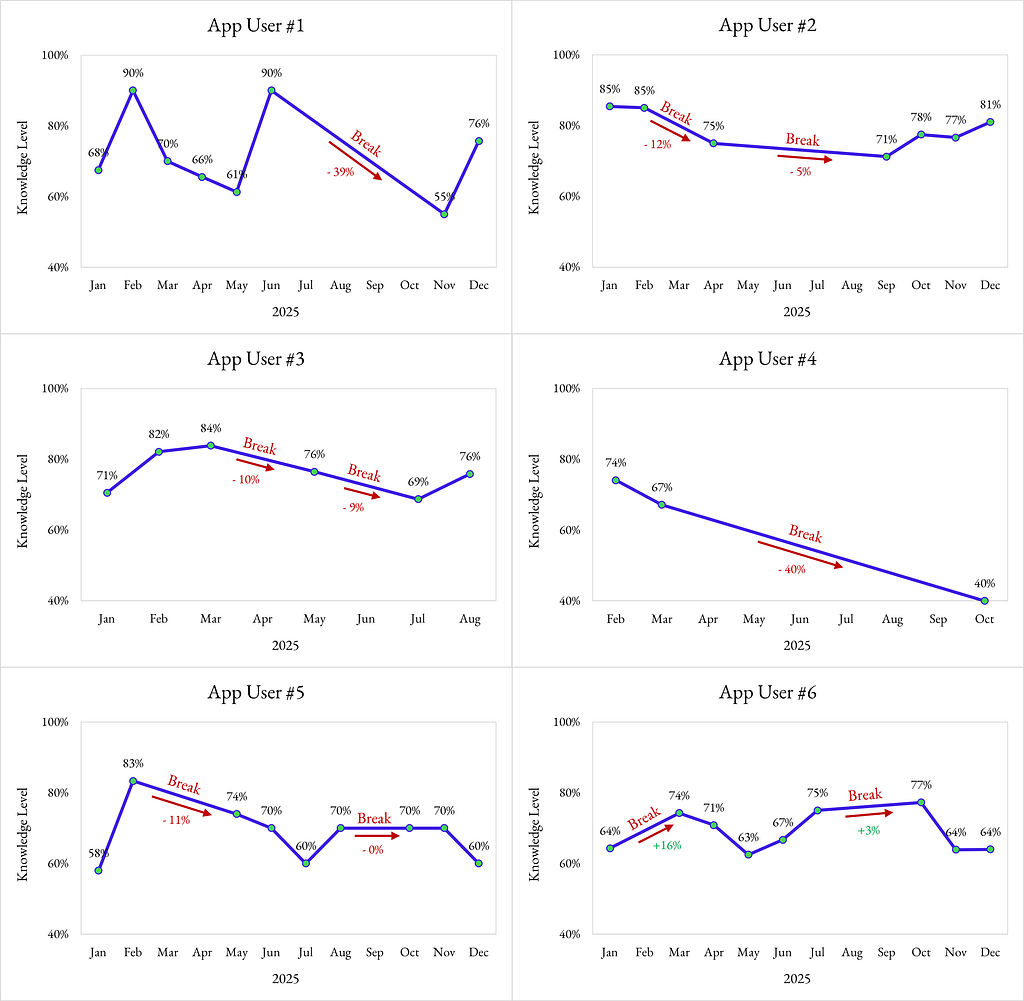
Below, you’ll see data from six members of the US Air Force who began using Blank Slate in early 2025 to maintain highly technical, job-relevant knowledge. These six were selected because they each experienced one or more periods of complete non-use due to limited system access.
Here’s how to read these graphs:
- Green dots reflect average knowledge levels during months when the user engaged at least weekly.
- Red arrows indicate long breaks with no Blank Slate use, with percentage changes in knowledge labeled for each period.
The Key Takeaways
1. Knowledge loss after breaks is common.
Most app users showed a decline following a blackout period. For some, the drop was modest; for others, it was substantial. This variability is exactly what cognitive science predicts: retention highly depends on both the length of the break and a person’s level of mastery before the break. But there are always exceptions: App User #6 stands out as a genuine outlier, having maintained performance despite time away.
2. Longer breaks generally mean larger declines.
Compare App Users #1 and #4, who experienced extended gaps, with App Users #3 and #5, who skipped only a month or two. Short interruptions were often absorbed with little loss. Longer disruptions were more costly, with App Users #1 and #4 both losing about 40% of their pre-break knowledge.
3. Recovery is fast once training resumes.
When users returned to consistent Blank Slate use, knowledge levels often rebounded quickly. App Users #1, #2, and #3 all showed clear improvement within a month of resuming use. This suggests that prior learning was efficiently restored through Blank Slate’s individualized practice once these users re-engaged.
The Bottom Line
Consistent Blank Slate use helps memory weather the storm, even when real-world demands force a pause. Short breaks are manageable. Longer breaks carry more risk, especially for highly technical material that hasn’t yet reached high proficiency.
For current Blank Slate clients: If uninterrupted training isn’t possible, build strong mastery before the break and resume Blank Slate as soon as feasible afterward. If you’re managing a team, consider lightly increasing review limits in the Hub before a known break. If you’re a user, head over to the Library after each session to get in some extra reps.
____
Amy Smith, PhD
Chief Scientific Officer, Blank Slate Technologies