The Bottom Line Up Front
In our recently published study, nursing staff who used Blank Slate kept critical safety knowledge sharp, felt more confident applying it, and adhered more consistently to fall-prevention protocols in the workplace [1]. These improvements show that continuous micro-refreshers, like those delivered through Blank Slate, can directly impact job performance and reduce workplace risk.
The Full Story
After completing workplace safety training, knowledge fades without continued reinforcement. In high-stakes settings like healthcare, even slight decreases in memory recall can increase workplace risk and contribute to preventable errors.
In a new study published in the Journal of Patient Safety, Gary Giumetti and colleagues [1] investigated whether nursing staff’s use of the Blank Slate app could help address a critical challenge in healthcare: improving adherence to patient fall-prevention protocols.
The research question: Does improving knowledge improve behavior?
Giumetti and colleagues aimed to determine whether having nursing staff use Blank Slate to stay current on patient safety procedures would result in better adherence to fall-prevention protocols on the job. They also wanted to examine whether using the platform would boost employees’ confidence in their ability to prevent patient falls.
These behavioral outcomes matter deeply. When nurses know what to do, feel capable of doing it, and actually do it consistently, the care environment is safer [2, 3].
The method: Real nurses, real settings, real behavior
The research team recruited practicing nurses and patient care associates from two neurology units and had them use Blank Slate for six weeks. A few times each week, the app delivered short, high-value questions about medication safety, patient monitoring, fall-prevention procedures, and other core topics, giving nurses a fast, low-burden way to keep critical knowledge active.
At the beginning and end of the study, researchers compared:
- Knowledge proficiency on app content
- Completion of fall-prevention checklists in each patient’s room
- Nursing staff’s confidence in their ability to prevent patient falls, as well as other attitudinal measures.
This design allowed the team to see how knowledge improvements related to safety practices and job confidence.
The results: 2x better adherence to fall-prevention protocols and 19% higher job confidence
Nursing staff that consistently used Blank Slate reaped the benefits:
- Their knowledge of fall-prevention safety procedures jumped from about 60% to 80% throughout the study.
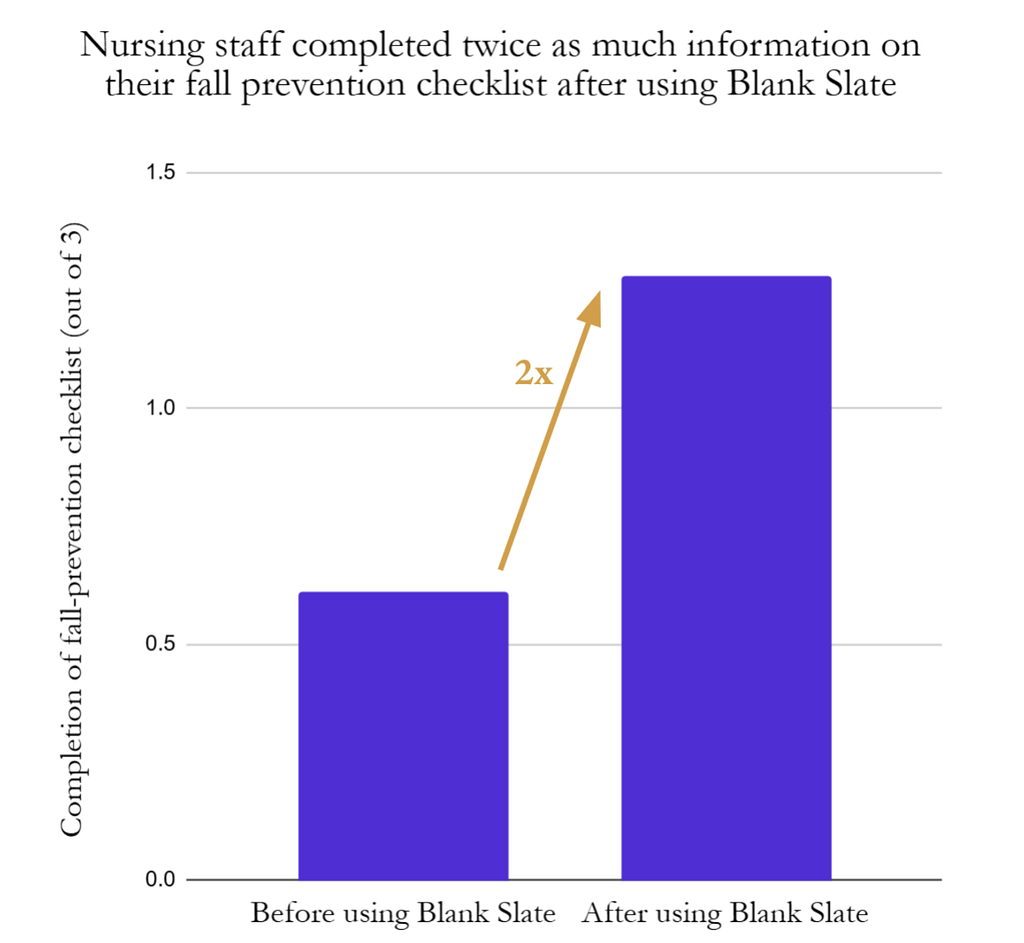
- Staff across both neurology units were twice as likely to complete fall-prevention checklists at the end of the study, behavior that directly reduces patient harm and workplace risk.
- Staff who used the app reported a 19% increase in their confidence to prevent patient falls, a crucial predictor of real-world effectiveness.
Implications: Stronger Performance, Lower Risk
These findings highlight a simple but powerful truth: When workers regularly refresh essential knowledge, they don’t just remember more, they make better decisions and follow safer practices. In safety-critical fields, those improvements translate into fewer errors, greater reliability, and reduced overall risk.
That’s precisely what the Blank Slate app is built to support. By delivering continuous, bite-sized refreshers on key training, Blank Slate helps employees maintain the knowledge, confidence, and practices that keep workplaces safe. It’s not just a learning tool; it’s a proactive strategy for building a safer, more resilient workforce.
References
- Giumetti, G. W., Bulger, C. A., Matthews, C. M., Tady, M. J., & Smith, A. M. (2025). Frequent use of a spaced-retrieval mobile app improves self-efficacy and adherence to safety protocols in nursing staff: A pilot study. Journal of Patient Safety, https://doi.org/10.1097/PTS.0000000000001426
- Dykes, P. C., Carroll, D. L., Hurley, A., Lipsitz, S., Benoit, A., Chang, F., Meltzer, S., Tsurikova, R., Zuyov, L., & Middleton, B. (2010). Fall prevention in acute care hospitals: a randomized trial. JAMA, 304(17), 1912–1918. https://doi.org/10.1001/jama.2010.1567
- Alanazi, F. K., Lapkin, S., Molloy, L., & Sim, J. (2023). The impact of safety culture, quality of care, missed care and nurse staffing on patient falls: A multisource association study. Journal of clinical nursing, 32(19–20), 7260–7272. https://doi.org/10.1111/jocn.16792
____
Amy Smith, PhD
Chief Scientific Officer, Blank Slate Technologies