The Bottom Line Up Front
Viewed through the rigorous framework of the Kirkpatrick Model, Blank Slate holds up, showing measurable benefits for learners, their job performance, and the organizations they serve.
The Details
Many organizations use Blank Slate to enhance — or replace — their traditional training programs. But with every new training tool comes a familiar challenge: demonstrating that it actually works.
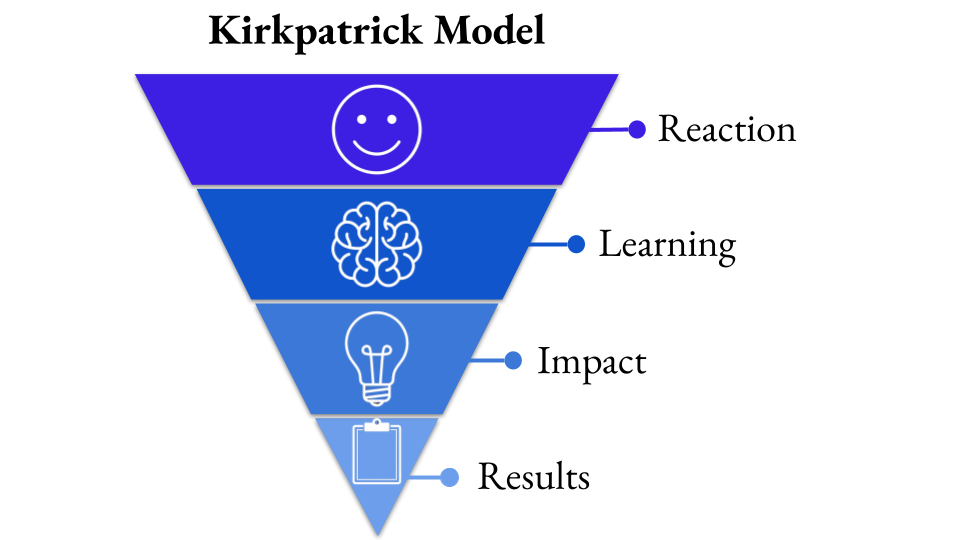
One of the most widely used frameworks for evaluating training effectiveness is the Kirkpatrick Model, developed by Donald Kirkpatrick in 1959 [1, 2]. The model proposes four levels of training evaluation: Reaction, Learning, Impact, and Results. Examining Blank Slate through this framework highlights how the platform supports training effectiveness at every stage.
Level 1: Reaction
The first level of the Kirkpatrick model asks whether learners found the training engaging and valuable. Through brief surveys delivered to our end users over the years, we’ve kept a pulse on people’s perceptions of Blank Slate’s likability and effectiveness.
Three examples below highlight the overwhelmingly positive perceptions on both fronts: airport staff report enjoying the platform, medical students found it to be a helpful tool for learning course content, and security guards feel it has improved their workplace performance. These results are especially noteworthy given that Blank Slate is mandated in all of these contexts.
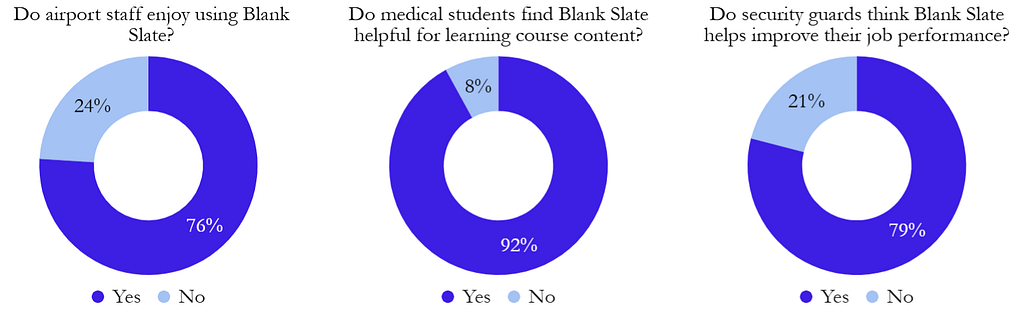
Blank Slate end-users find the platform to be both enjoyable and effective. Those surveyed include 304 people sampled across airport staff, medical students, and security guards.
Level 2: Learning
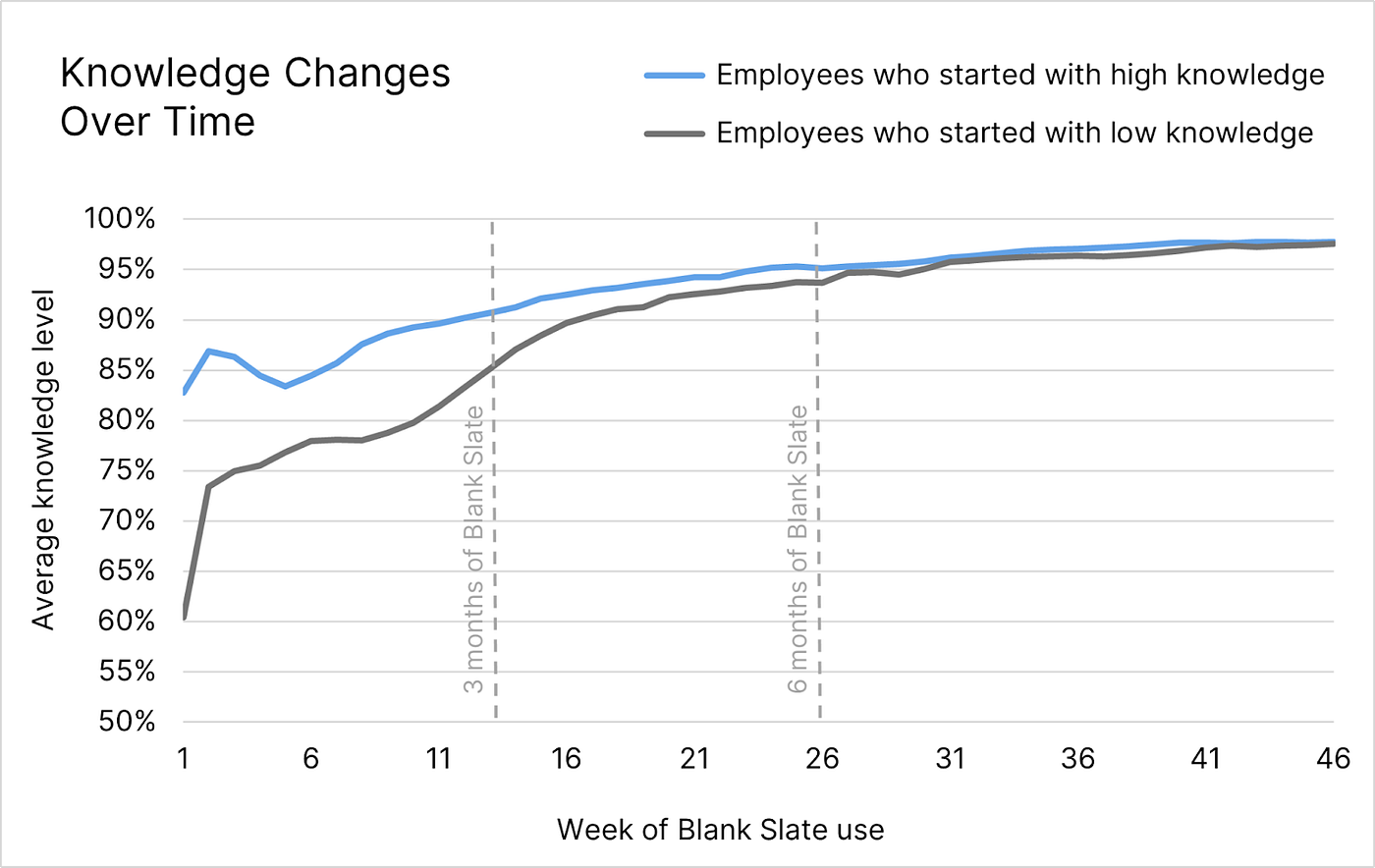
The second level of the Kirkpatrick model evaluates whether employees actually learned the intended material during training. Because Blank Slate both reinforces and assesses knowledge, it is well suited to measure its effectiveness at promoting learning. Each user interaction provides a direct measure of whether a learner can successfully recall their training.
We’ve talked about how effective Blank Slate is at supporting long-term knowledge retention many times before in the context of Air Force paramedics, people with Alzheimer’s disease [3], security guards, nursing staff [4], and more. To highlight the power of learning with Blank Slate, the graph below compares knowledge accuracy for people who watched a lecture and then did no additional training for a month (pink line) with those who used Blank Slate to learn the same new lecture material (blue line) [5].
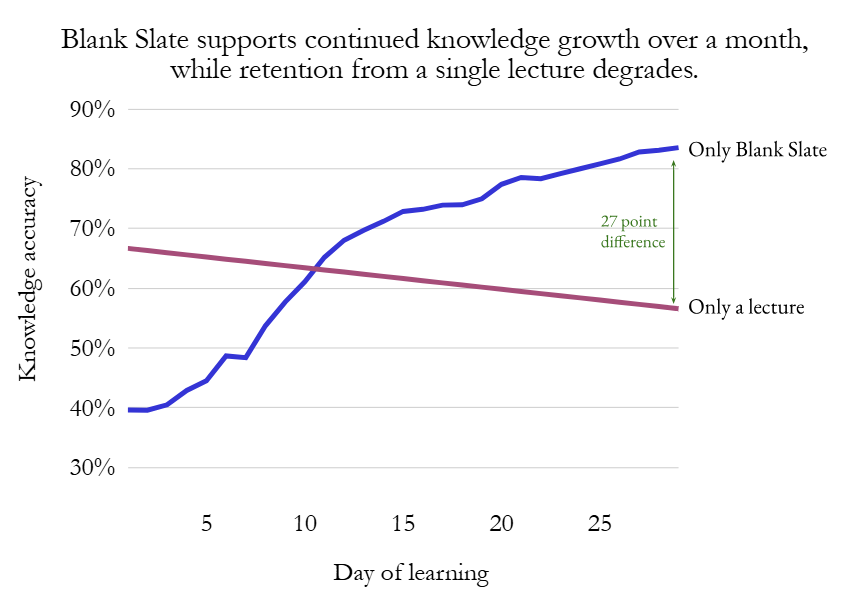
In a one-month study, learners using Blank Slate (blue line) showed far better learning outcomes than those who watched a lecture without reinforcing the material afterward (pink line) [5].
Level 3: Impact
The third level, also called the behavior level, examines whether there is evidence that training had a measurable impact on learners’ behavior on the job. This level can be challenging to measure because job performance depends on many factors beyond whether someone knows the training content — from motivation and workplace conditions to something as simple as whether they’ve been getting enough sleep.
Even so, over the years we’ve collected substantial data from our clients, and several findings point to the real-world performance impact of using Blank Slate:
- Nursing staff who used Blank Slate adhered to fall-prevention protocols twice as thoroughly as those who didn’t [4].
- Air Force trainees who used Blank Slate were nearly twice as likely to pass a live care-under-fire simulation as those who didn’t.
- Facilities maintenance workers who used Blank Slate were better able to solve novel workplace problems related to the content they trained on.
Taken together, these findings suggest that consistent training with Blank Slate translates into meaningful improvements in on-the-job performance. Level 3 conquered, on to Level 4.
Level 4: Results
The final level evaluates whether training leads to meaningful organizational results. By providing organizations with first of its kind visibility into knowledge risk across organizations, Blank Slate, by nature, provides organizations with meaningful results right off the bat.
Beyond the clear operational impact of tracking knowledge across teams, improvements in workforce knowledge can drive additional positive outcomes for organizations. When employees consistently retain critical information, organizations can expect downstream outcomes such as fewer errors, stronger compliance, and improved performance.
While these outcomes can be difficult to measure directly, we have heard compelling results from our clients. One security organization with more than 300 personnel using Blank Slate weekly has reported 40% fewer operational incidents after adopting the platform as a training solution three years ago.
Wrapping it All Up
Viewed through the lens of the Kirkpatrick Model, Blank Slate does more than deliver training — it provides continuous evidence that training is working. From learner engagement to knowledge retention, behavioral change, and organizational outcomes, the data consistently point in the same direction: when training is reinforced over time, people remember more and perform better.
References
- Kirkpatrick, D. L. (1959). Techniques for Evaluating Training Programs. Journal of the American Society of Training Directors.
- Kirkpatrick, D. L. (1994). Evaluating Training Programs: The Four Levels. Berrett-Koehler.
- Smith, A. M., Marin, A., DeCaro, R. E., Feinn, R., Wack, A., Hughes, G. I., Rivard, N., Umashankar, A., Turk, K. W., & Budson, A. E. (2024). Algorithmic Spaced Retrieval Enhances Long-Term Memory in Alzheimer Disease: Case-Control Pilot Study. JMIR formative research, 8, e51943. https://doi.org/10.2196/51943
- Giumetti, G. W., Bulger, C. A., Matthews, C. M., Tady, M. J., & Smith, A. M. (2026). Frequent use of a spaced-retrieval mobile app improves self-efficacy and adherence to safety protocols in nursing staff: A pilot study. Journal of patient safety, 22(2), 121–126. https://doi.org/10.1097/PTS.0000000000001426
- Gordon, L.T., Hughes, G. I., & Smith, A. M. (2025). Modernizing the flipped classroom: Replacing lecture time with asynchronous spaced retrieval. Teaching of Psychology. https://doi.org/10.1177/00986283251325842
____
Amy Smith, PhD
Chief Scientific Officer, Blank Slate Technologies