The Bottom Line Up Front
Organizational IQ represents how well knowledge is retained and shared across an organization, and it constantly degrades through forgetting, fragmentation, and miscommunication. Blank Slate offers a solution: a system that continuously reinforces knowledge, preserves institutional memory, and keeps organizations aligned.
The Details
Every organization has a collective intelligence — an organizational IQ — that determines how well it learns, retains knowledge, makes decisions, and innovates. Organizational IQ isn’t about how smart the people are who work there. It encompasses an organization’s structure, culture, knowledge management practices, and strategic processes, the full architecture through which information becomes action [1].
Just like with individual intelligence, organizational IQ can fluctuate. At every layer of an organization — individual, team, and leadership — knowledge can get lost or distorted.
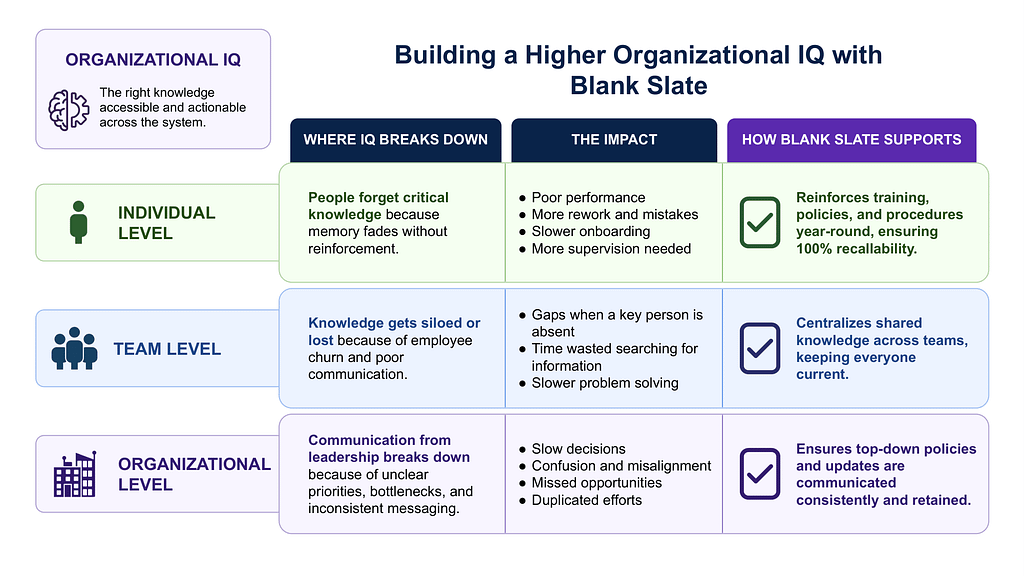
At the individual level, the biggest threat is simple: people forget. Decades of cognitive science research show that memory declines rapidly without reinforcement. Even well-designed training programs lose effectiveness if knowledge is not revisited and applied. The result is a workforce with a lot of quietly degrading expertise.
At the team level, the problem shifts from forgetting to fragmentation. Teams often rely on what organizational psychologists call transactive memory systems [2], the shared understanding of “who knows what” within a group. When teams distribute and coordinate knowledge, they function well. But when team members are siloed, the absence of one person can create major capability gaps, and teams spend more time searching for information than applying it.
At the organizational level, declines in organizational IQ are often driven by leadership and communication breakdowns. Here, the issue isn’t just missing knowledge, it’s misaligned knowledge. When leaders fail to communicate priorities clearly, or when messaging is inconsistent across layers of the organization, confusion spreads. Different teams may operate with conflicting assumptions or duplicate their efforts.
So how do you stabilize and elevate organizational IQ across all these levels?
This is where Blank Slate, as a continuous knowledge support platform, becomes critical.
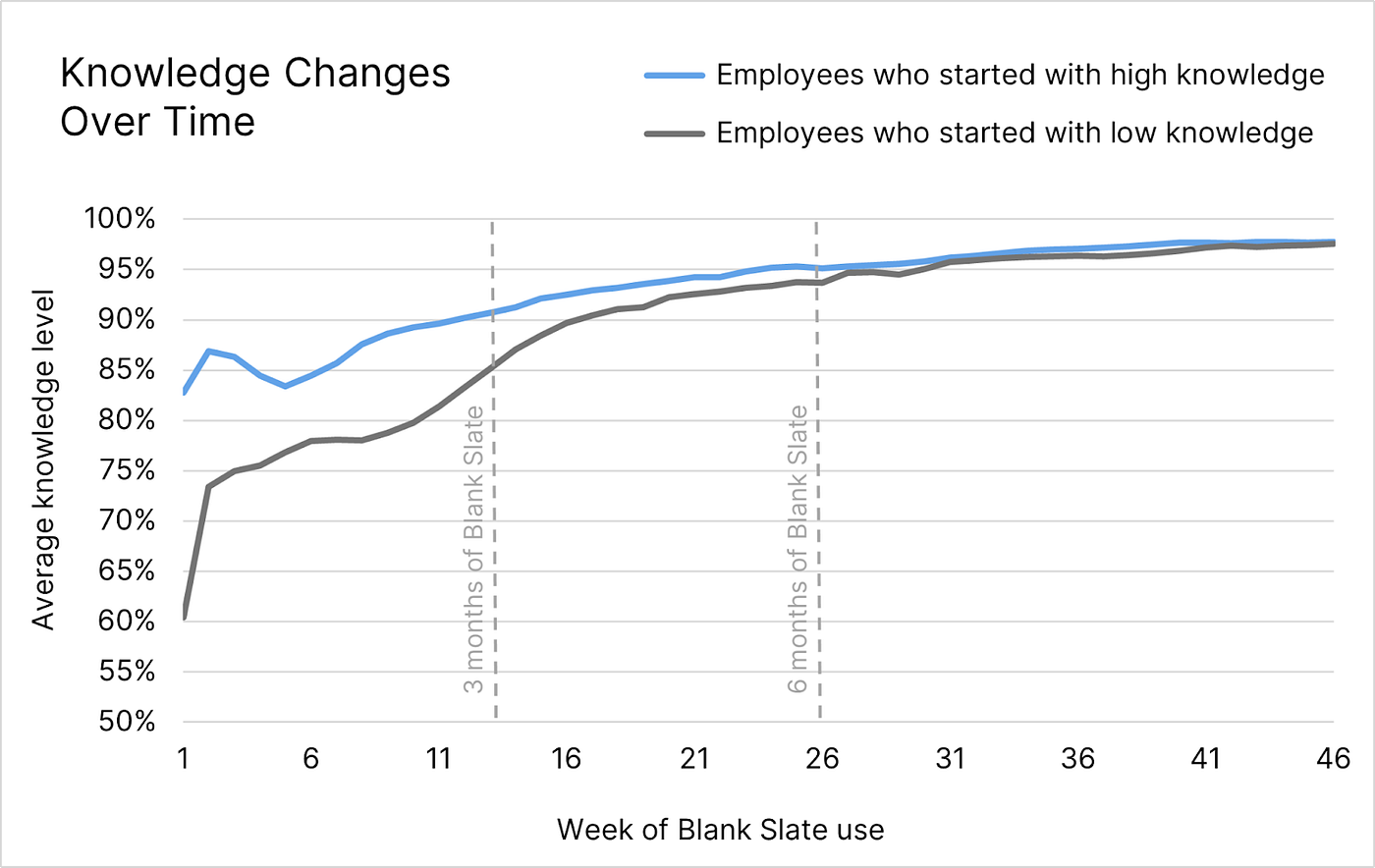
At the individual level, Blank Slate replaces the “train and forget” model with continuous, reinforced knowledge. Instead of relying on employees to retain everything from a single onboarding session or annual compliance training, Blank Slate keeps critical knowledge both relevant and accessible.
At the team level, people can use Blank Slate to share and access institutional knowledge through a structured platform. New hires can learn about the roles and capabilities of the other people on their team. Departing employees can share tribal knowledge before it’s lost. Silos weaken as information flows freely across all team members.
At the organizational level, Blank Slate gives leadership a direct channel to disseminate priorities, updates, and strategic direction clearly and regularly. Instead of a memo that gets buried in inboxes or a town hall that’s forgotten by Friday, leadership communications can be delivered, tracked, and reinforced over time.
In a world where knowledge is constantly evolving, organizational IQ is not something that is achieved once, it’s something that is maintained. Blank Slate makes that maintenance possible, transforming knowledge from a fragile asset into a durable, organization-wide capability.
References:
- Glynn, M. A. (1996). Innovative genius: A framework for relating individual intelligences to innovation. The Academy of Management Review, 21(4), 1081–1111. https://doi.org/10.2307/259165
- Wegner, D. M. (1987). Transactive memory: A contemporary analysis of the group mind. In B. Mullen & G. R. Goethals (Eds.), Theories of group behavior (pp. 185–208). Springer. https://doi.org/10.1007/978-1-4612-4634-3_9
_____
Amy Smith, PhD
Chief Scientific Officer, Blank Slate Technologies