Many of life’s ambitions take a painfully long time to produce results. If you’re trying to put on muscle, a new strength-training program will take an average of four weeks before you’ll see measurable gains [1]. If you’re trying to build a new daily habit, like going to bed earlier or taking a daily walk, research shows it’ll take somewhere around 66 days before the habit sticks [2].
Mercifully, mastering knowledge is different. The neural networks that support knowledge can strengthen in just a few encounters with information, particularly if they are optimally spaced over time.
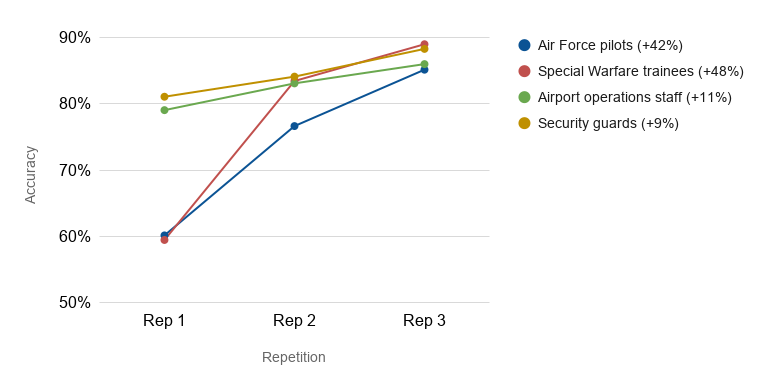
Data from over 500 people across four very different groups using Blank Slate show what that looks like in practice: U.S. Air Force pilots, U.S. Air Force Special Warfare trainees, airport operations staff, and security guards. The analysis tracks how accurately each group recalled the same training items the first, second, and third time they encountered them, with each attempt occurring during a different session.
That part is worth repeating: these weren’t three attempts on the same day. They were three brief reviews of the same fact, delivered at precisely the right time, as determined by Blank Slate’s custom-built AI scheduler. Each attempt was separated by a few days to a few weeks.
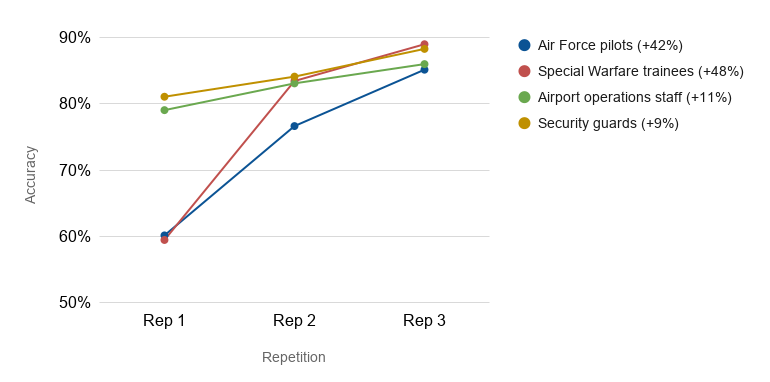
Like clockwork, every organization followed the same climb. Pilots’ accuracy started close to a coin flip and reached 85% by the third pass. Special Warfare trainees went from 60% to 89%. Security guards and airport staff started around 80% and ended up near 90% on their third try.
Two things from these findings should be underscored:
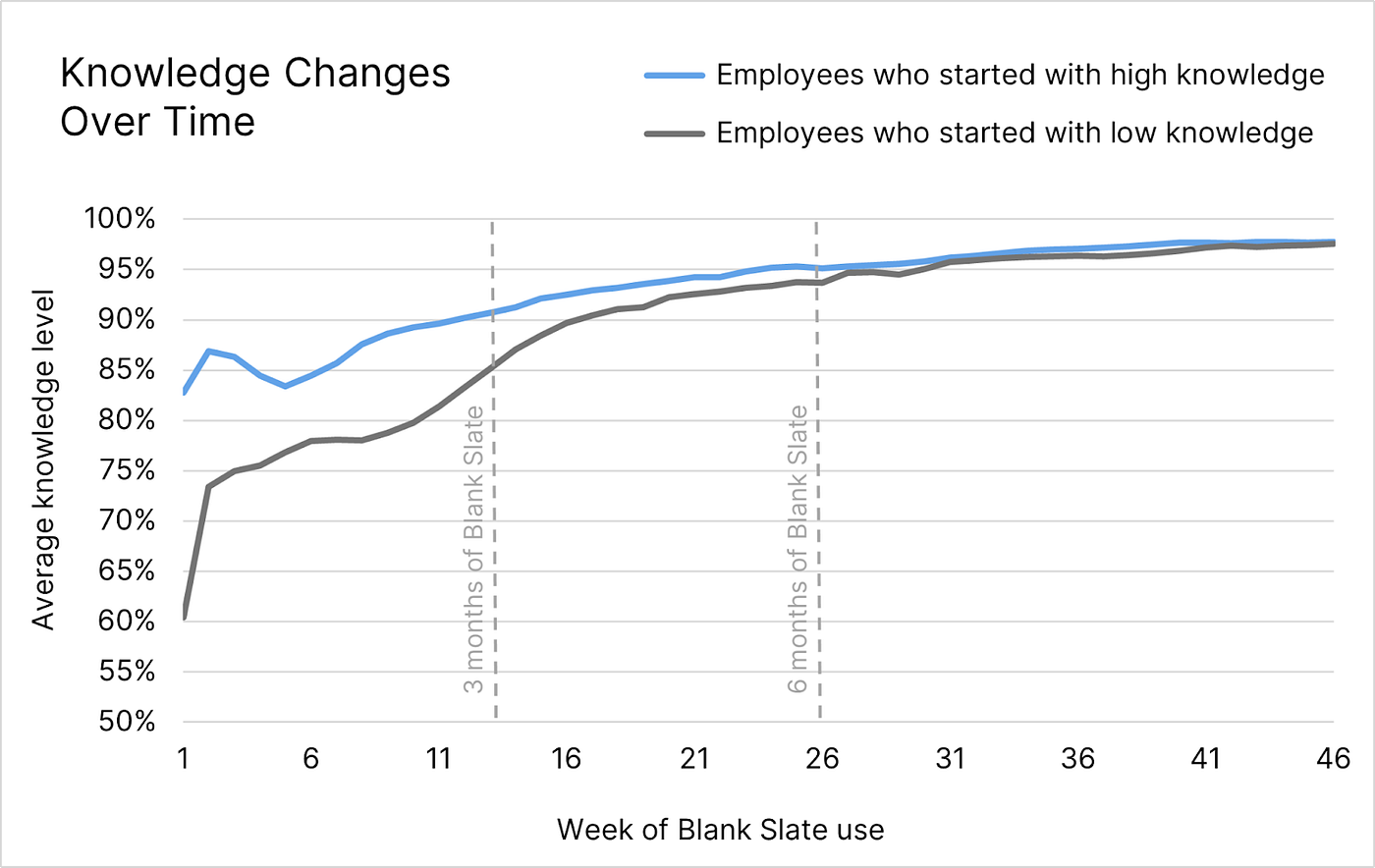
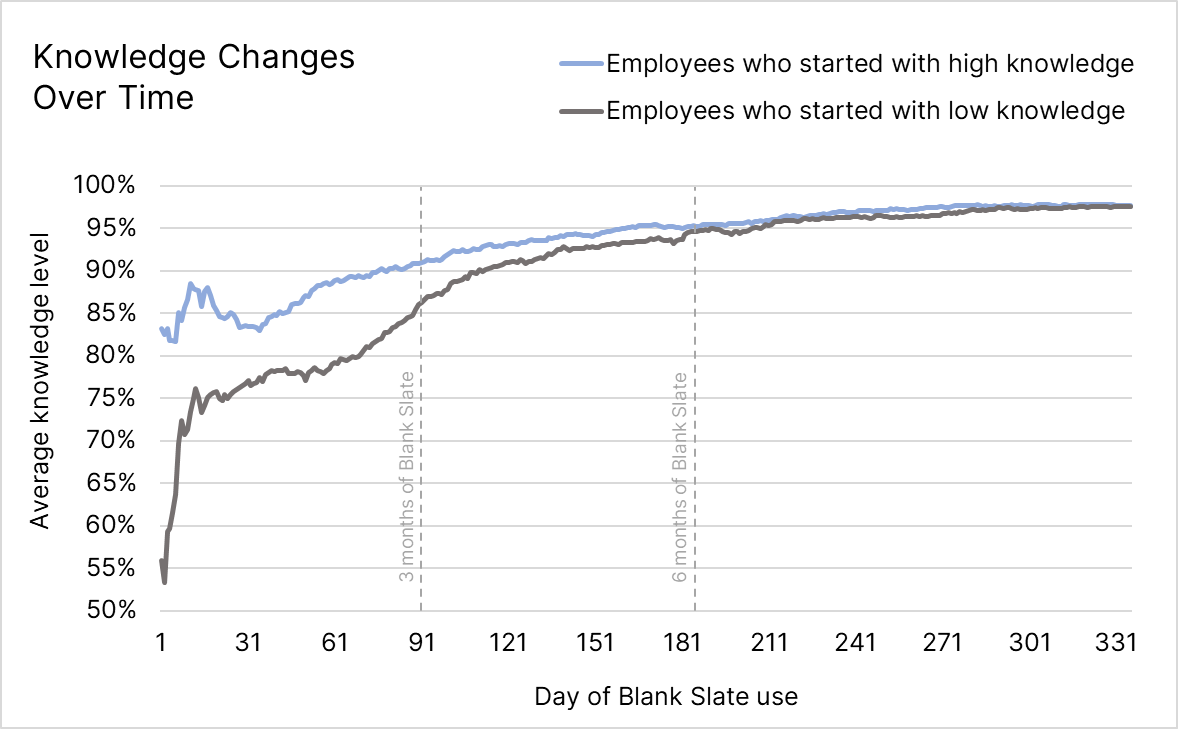
- All of these people were highly qualified to do their jobs but had forgotten some of their training, as human brains are known to do. These knowledge gaps are silent killers that exist in every workforce. And as the chart shows, the blame falls on a suboptimal training regimen, not suboptimal employees.
- Regardless of where knowledge levels started for each team, everyone recovered their lost knowledge to roughly the same level of 85–90% accuracy. Done right, optimized training is an equalizer across workforces.
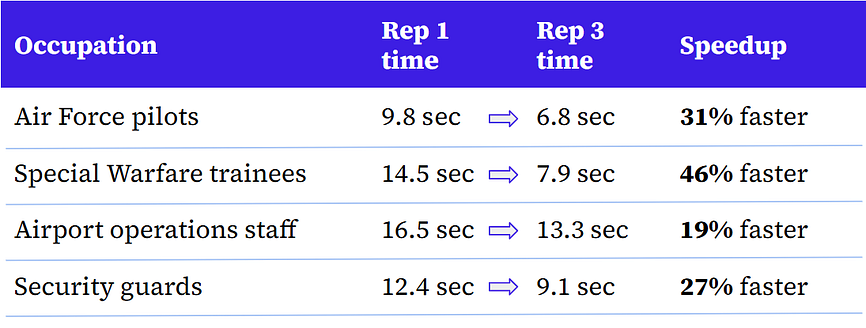
Response times also dropped with every repetition, in every group. People were up to 46% faster by their third attempt, demonstrating another signature of strong learning: not just accuracy, but efficiency.
That distinction is especially impactful in high-stakes settings. A pilot running a checklist under time pressure doesn’t have the luxury of pausing to recall something — they need to already know it, instantly. The gap between “eventually correct” and “instantly correct” is exactly the gap this data is tracking, and it closes fast.
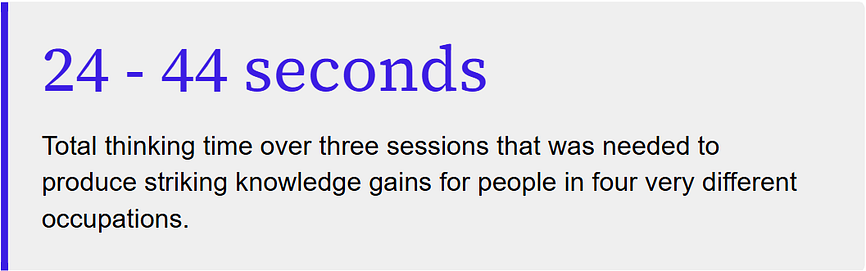
We said that mastering knowledge was different from strength training or forming a new habit, and here’s the most impressive reason why: when you add up the total thinking time required to refresh on each critical protocol, procedure, or regulation, it comes to just 24–44 seconds. Compare that to four weeks of training for building muscle, or 66 days for a habit to become automatic.
These microsessions aren’t a productivity trick, though that may be a nice side effect. The speed and effectiveness shown in these data are simply the guaranteed result of the optimized spaced practice that Blank Slate delivers. For teams operating in environments with no risk tolerance, consider what 44 seconds of practice could do for each essential piece of job knowledge.
References
- Staron, R. S., Karapondo, D. L., Kraemer, W. J., Fry, A. C., Gordon, S. E., Falkel, J. E., Hagerman, F. C., & Hikida, R. S. (1994). Skeletal muscle adaptations during early phase of heavy-resistance training in men and women. Journal of Applied Physiology, 76(3), 1247–1255.
- Lally, P., van Jaarsveld, C. H. M., Potts, H. W. W., & Wardle, J. (2010). How are habits formed: Modelling habit formation in the real world. European Journal of Social Psychology, 40(6), 998–1009. https://doi.org/10.1002/ejsp.674
___
Amy Smith, PhD
Chief Scientific Officer, Blank Slate Technologies