The Bottom Line Up Front
New research shows that just four weeks of learning with Blank Slate produced memory benefits that lasted more than a year in people with early Alzheimer's disease.
The Details
In 2024, we published research showing something remarkable: people with early Alzheimer's disease could learn new information and recover faded memories using Blank Slate.
The results were striking. After just four weeks of using Blank Slate, participants improved their memory for new facts by 76% and their ability to recognize previously forgotten names by 22%. They achieved these gains in an average of about 3 minutes of app use per day.
But we were left with an important question: How long would those memories last?
Alzheimer's disease progressively impairs the brain's ability to form and retrieve memories. While our original findings showed that memory could improve despite this impairment, we didn't know whether those improvements would survive the passage of time.
So, more than a year later, we went back to find out.
The Ultimate Memory Test
Our new study, published in the journal Archives of Clinical Neuropsychology, followed up with 25 participants from the original research: 12 people diagnosed with mild cognitive impairment (MCI) due to Alzheimer's disease and 13 cognitively healthy people over 65.
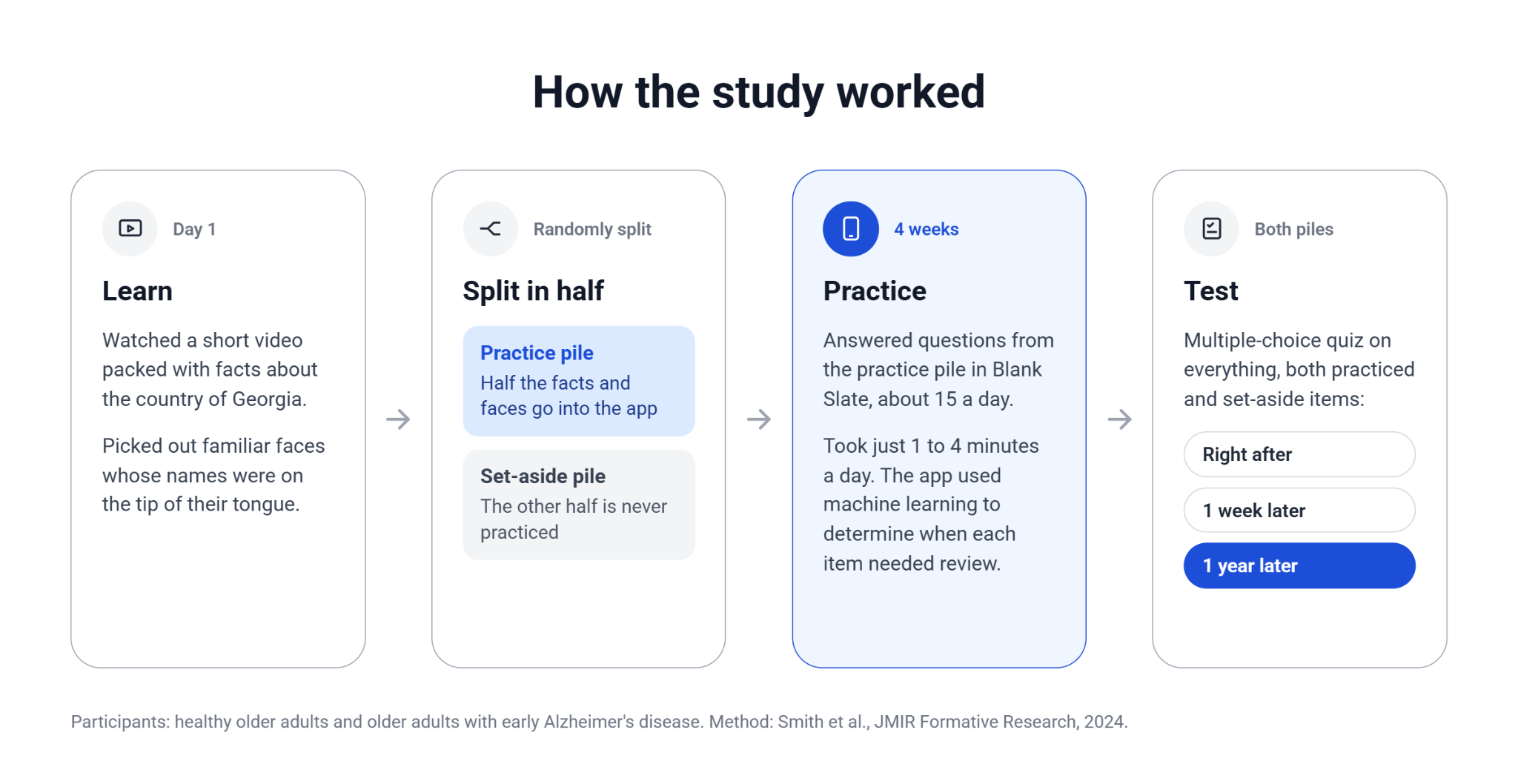
In the original study we published in 2024, participants had used Blank Slate to practice remembering two types of information: facts about the country of Georgia, which they had recently learned, and names of familiar celebrities they could no longer recall.
Crucially, only half of the information was practiced with Blank Slate. The other half served as a comparison, allowing us to measure how much of a difference the app made.
After the original study ended, participants lost access to Blank Slate. They weren't told we'd be testing their memories again. Then, about 12 months later, we surprised them with the same memory test.
Some of the Memories Actually Survived
Even after more than a year without Blank Slate, participants remembered information they'd practiced with the app significantly better than information they hadn't practiced.
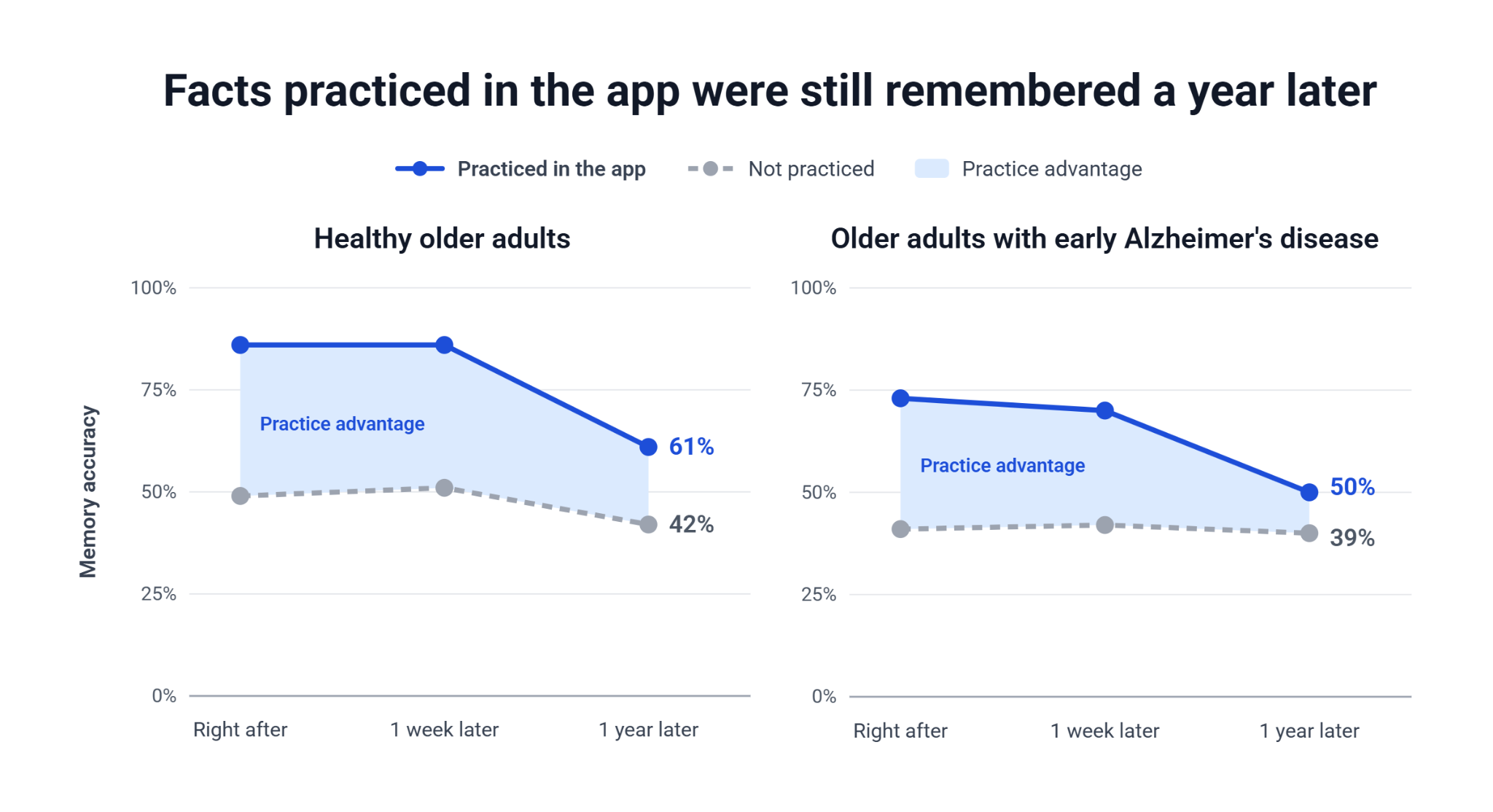
People with MCI due to Alzheimer’s disease remembered new facts 28% better, scoring 50% accuracy on practiced information versus 39% on unpracticed information. They remembered familiar names 9% better, scoring 86% accuracy on practiced associations versus 79% on unpracticed associations.
As you can see in the graph above, both healthy older adults and those with MCI due to Alzheimer's disease benefitted from the app. These findings suggest that even when the brain's memory systems are compromised by Alzheimer's, strategically strengthening memories can help them endure.
What this Could Mean for Alzheimer's Care
Imagine helping someone with early Alzheimer's relearn the name of a neighbor, remember important personal information, or retain something new about the world around them.
Now imagine those memories lasting not just days or weeks, but more than a year.
Our research doesn't establish that Blank Slate improves everyday independence or slows Alzheimer's progression. Those are questions for future studies. But it does demonstrate something promising: A relatively small investment of time in memory training can produce benefits that persist remarkably long after training ends.
For people facing a disease defined by forgetting, that's an encouraging possibility.
----
Amy Smith, PhD
Chief Scientist, Blank Slate Technologies