
Most organizations can tell you exactly who finished a training course. Far fewer can tell you who still remembers it, or who could apply it under pressure next Tuesday. Completion tracking answers a compliance question; it was never built to answer a readiness question, and confusing the two is where most training measurement quietly breaks down.
The Completion Trap
A completion rate tells you attendance happened. It confirms a course was opened, a video was watched, a quiz was passed once. What it doesn't tell you is whether the material survived contact with the following week, let alone the following quarter.
This isn't a flaw in any particular course platform; it's a structural limitation of point-in-time measurement. An LMS is built to track progress through content: modules assigned, modules completed, certificates issued. That's a legitimate and necessary record. But it answers "did this happen," not "does this person still know it." Retention and readiness are separate questions, and they require a separate layer of measurement, one that sits alongside your existing training system rather than replacing it.
The gap shows up first in high-consequence teams, where the cost of "completed but not retained" is a missed step, a slow response, or a preventable error. But the same gap exists in any team where knowledge needs to be there when it's needed, not just on file when it's audited.
What Most Teams Track vs. What Actually Predicts Readiness
- What most teams track: Completion rate (did they finish the course) · What actually predicts readiness: Retention curve (do they still know it 30/60/90 days later)
- What most teams track: Course completion date · What actually predicts readiness: Time-to-recall under pressure
- What most teams track: Quiz score at the end of the course · What actually predicts readiness: Rate of knowledge decay between reinforcement sessions
- What most teams track: Org-wide completion dashboard · What actually predicts readiness: Readiness broken out by team and by role
- What most teams track: A static certificate, valid until the next refresh cycle · What actually predicts readiness: A real-time readiness metric that updates continuously
The left column is a record of activity. The right column is a record of capability. Both matter, but only one of them tells a leader whether their team can perform when it counts.
The Metrics That Actually Matter
If completion isn't the right proxy, what should leaders be looking at instead? A useful readiness scorecard tends to include:
- Retention over time: not a single post-course score, but a curve showing how much knowledge is retained at set intervals after training ends.
- Time-to-recall: how quickly a team member can retrieve the correct answer or procedure, which correlates more closely with real-world performance than whether they can eventually find it.
- Decay rate between reinforcement: how fast knowledge erodes without a refresher, which tells you how often reinforcement actually needs to happen (rather than guessing at a recertification calendar).
- Readiness by team and by role: an org-wide average hides the team that's slipping. Readiness has to be visible at the level where a leader can actually act on it.
- A live readiness signal: a number that reflects current state, not a snapshot frozen at the moment a course was closed out.
From Point-in-Time Scores to Real-Time Readiness
This is the shift Blank Slate was built around: replacing a point-in-time completion score with a continuously updated readiness measurement. Blank Slate calls this metric True Knowledge Level™: a live indicator of what a person or team actually knows right now, derived from ongoing, adaptive recall checks rather than a single test taken once and never revisited.
The mechanism behind it is a few minutes of adaptive, spaced-repetition-based engagement per week, layered on top of whatever training program and LMS a team already runs. It doesn't replace the course catalog or the certification record. It answers the question the catalog can't: is this still true today? The pattern holds at scale: across 880,000 user engagements spanning 19 client deployments, users improved an average of 10 percentage points, from 77% to 87%, by just the third time they answered a question (Blank Slate platform data, 2024).
The evidence for this approach is published, much of it peer-reviewed. In a 16-week study of U.S. Air Force Special Warfare (Pararescue) trainees, knowledge accuracy rose from 67% to 81% on an average of about 100 seconds of app use per week (I/ITSEC 2023). In a separate randomized controlled trial, Blank Slate matched daily review's retention in about one-third of the study time, while the no-review control group's scores declined (McHugh et al., 2021). Among F-16 and C-17 pilots tracked over 16 months, first-attempt knowledge accuracy improved from 66.9% to 81.4%, a 21.6% relative gain, and 18 of the 19 pilots surveyed wanted to keep using the platform after the study ended (Smith & Randolph, I/ITSEC 2026). And in a hospital pilot with Mass General nursing staff, six weeks of short daily reviews significantly improved fall-prevention knowledge, self-efficacy, and safety-checklist completion (Journal of Patient Safety, 2025): behavior change you can measure, not just courses you can count.
None of these are training-completion numbers. They're retention numbers, recall-speed numbers, and outcome numbers, which is the entire point.
Tracking by Team and Role, Not Just by Organization
A single org-wide completion percentage can look healthy while masking a team that's operationally exposed. Readiness measurement only becomes useful to a leader when it's segmented by team, by role, and by shift, because that's the level at which a gap can actually be closed.
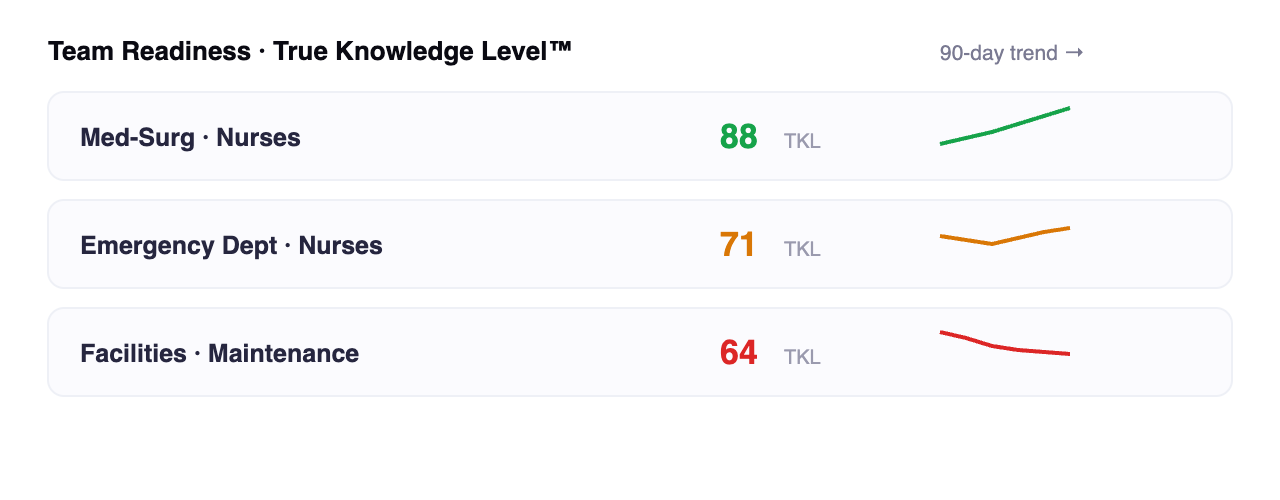
This is also where a real-time metric outperforms a periodic one. A quarterly assessment tells you where a team stood on the day of the test. A continuously updated readiness score tells you where they stand today, which is the version of the answer that actually informs a staffing decision, a deployment call, or a targeted refresher. Pairing this kind of live view with a structured Knowledge Gap Audit gives leaders both the current state and a prioritized list of where to close gaps first.
Frequently Asked Questions
Is tracking employee training the same as measuring readiness?
No. Training tracking confirms that content was delivered and completed. Readiness measurement confirms that the knowledge is still present and retrievable when it's needed, which is a separate, and typically much smaller, number.
Does this replace our LMS or training program?
No. It's a measurement and reinforcement layer that runs alongside an existing LMS and training program, closing the gap between "completed" and "retained" without touching the underlying course content or compliance record.
What is True Knowledge Level™?
True Knowledge Level™ is a real-time readiness metric that reflects what a person or team currently knows, based on ongoing adaptive recall data rather than a single point-in-time test score.
How much time does this require from employees each week?
The engagement is designed to be minimal by design: short, adaptive sessions rather than another lengthy course. In the published USAF Special Warfare study, trainees averaged about 100 seconds of app use per week across 16 weeks, falling below one minute weekly as the material was mastered (I/ITSEC 2023).
Completion dashboards will keep telling you who finished. If you want to know who's actually ready (by team, by role, in real time), a Knowledge Gap Audit is the place to start. Request a Knowledge Gap Audit to see what your current training data isn't showing you.