
Every compliance program can produce a certificate. Far fewer can produce evidence that the person holding it still knows what to do six months later, under pressure, without looking it up. That gap is where audits get uncomfortable and where preventable incidents start. The best practices below are built around a different question than most compliance training asks: not "did they finish it," but "can they still perform it."
1. Measure Retention, Not Completion
Completion is a timestamp. Retention is a capability, and it decays on its own schedule regardless of what your LMS reports. The forgetting curve is a well-established idea in learning science: knowledge fades over time unless it's deliberately reinforced, and a single training session, however well delivered, is not enough to keep critical knowledge accessible months later.
The best-practice fix is to stop treating "100% completion" as the finish line and start tracking retention at intervals after training ends. That means re-testing knowledge weeks and months out, not just on the day of the course, and being honest about what the resulting curve shows. The stakes justify the effort: a meta-analysis of 90 studies found safety knowledge to be the strongest predictor of safety performance, ahead of attitudes, motivation, and supervisory support (Christian et al., Journal of Applied Psychology, 2009).
2. Test Application Under Pressure, Not Just Recall
Multiple-choice quizzes taken in a quiet room measure recognition. Real compliance failures happen in noisy, time-pressured, ambiguous moments: a nurse mid-shift, a security officer mid-incident, a technician mid-shutdown. Best-in-class programs build assessment that mirrors that pressure: scenario-based prompts, time constraints, and questions that require applying a rule rather than recalling its wording.
This is also where audit-defensibility starts to diverge from paperwork. A regulator or plaintiff's attorney asking "how do you know your people could actually do this" wants evidence of applied knowledge, not a list of attendees.
3. Reinforce on a Schedule That Fights Decay
If retention decays predictably, reinforcement should be scheduled predictably too, not left to an annual refresher. Spaced repetition, delivered in short, frequent touches rather than long infrequent ones, is the standard countermeasure to the forgetting curve. In a randomized controlled trial, McHugh et al. (2021) found this kind of adaptive, spaced approach matched daily review's retention in about one-third of the study time, and the control group that did no review at all didn't just plateau, it forgot.
The operative word is "adaptive": reinforcement that targets each person's specific weak points is more efficient than reinforcement that repeats material everyone already knows. That's the layer a knowledge-retention platform like Blank Slate is built to add on top of your existing LMS: it doesn't replace the course catalog or the completion records; it closes the gap between finishing training and being able to use it.
4. Track a Readiness Score You'd Defend to an Auditor
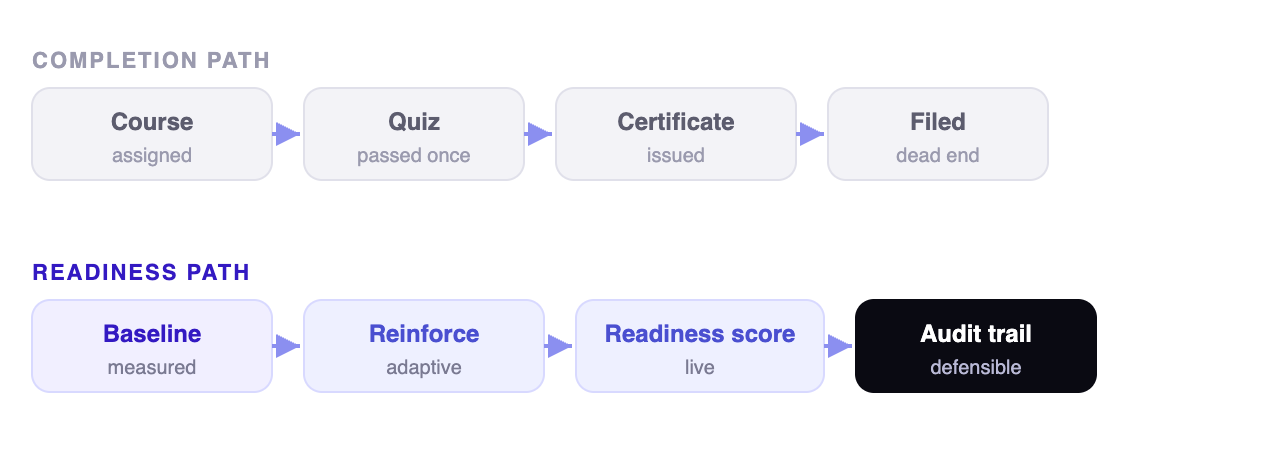
Attendance logs answer "who showed up." A readiness score answers "who could pass, right now, if tested." Programs built for audit-defensibility maintain the second kind of record: a continuously updated, individual-level measure of demonstrated knowledge, not a static badge issued once and never revisited.
This is the practical difference between a training file and audit-ready compliance documentation: one shows a course was assigned, the other shows the knowledge was still there when it mattered.
5. Close Individual Gaps, Not Just the Team Average
A department can hit 100% completion while several individuals are quietly unprepared on specific, high-consequence points. Averages hide exactly the people a compliance program exists to protect against. Best-practice programs identify and close gaps at the individual level, automatically re-surfacing the specific concepts a specific person is weak on, rather than re-running the same course for everyone.
6. Keep the Time Burden Sustainable
Programs fail adoption long before they fail comprehension: if reinforcement takes too much time, people route around it. The published USAF Special Warfare study (I/ITSEC 2023, Amy Smith, PhD) is instructive here: trainees averaged six to nine minutes of weekly app use in the first three weeks of the course, but by week 16 that had fallen below one minute per week, about 100 seconds on average across the full period, while knowledge accuracy rose from 67% to 81%. Well-targeted reinforcement gets cheaper over time, not more expensive, which is the opposite of what a bolted-on annual refresher does.
Fewer failures, not just faster study
The same I/ITSEC 2023 research also reported that app users had an 84% first-time pass rate on an applied knowledge test, versus a 46% first-time pass rate for non-users, a statistically significant association (p = .005), though an observational one. That is the kind of proof point that matters when a regulator asks what your program actually changed, not just what it covered.
7. Build a Feedback Loop From Incidents Back to Training
Compliance and safety data shouldn't dead-end in a spreadsheet. When an incident, near-miss, or audit finding occurs, the root-cause knowledge gap should feed back into what gets reinforced next, closing the loop rather than just logging it. A peer-reviewed nursing pilot co-authored with Mass General Hospital clinicians shows the training side of that loop: after six weeks of two-to-three-minute reviews of fall-prevention protocols each workday, nurses' first-attempt knowledge accuracy rose 17 points, their confidence in preventing falls climbed from 79 to 94 on a 100-point scale, and completion of bedside fall-prevention checklists more than doubled (Journal of Patient Safety, 2025). The small six-week pilot found no change in patient falls themselves, but the behaviors that prevent falls demonstrably improved. On the incident side, a data-center security firm's CEO reported 40% fewer operational incidents a year after adopting continuous reinforcement (a company-reported figure, presented at MODSIM World 2025). That's the outcome compliance training is actually supposed to produce: measurably better protocol execution, not more completed courses.
Completion-Based vs. Readiness-Based Compliance
- Dimension: What's measured · Completion-Based: Course finished, quiz passed once · Readiness-Based: Knowledge retained and demonstrable over time
- Dimension: Assessment style · Completion-Based: Recall, low time pressure · Readiness-Based: Applied, scenario-based, under pressure
- Dimension: Reinforcement cadence · Completion-Based: Annual or triggered by incident · Readiness-Based: Continuous, individually adaptive
- Dimension: What "pass" means · Completion-Based: Attended and answered correctly once · Readiness-Based: Currently able to perform correctly
- Dimension: Audit evidence · Completion-Based: Attendance and certificate records · Readiness-Based: Time-stamped, individual readiness scores
- Dimension: Link to incidents · Completion-Based: Rarely traced back to training gaps · Readiness-Based: Root-caused and fed back into reinforcement
Notice that none of this requires ripping out your LMS. Your LMS is still the system of record for what was assigned and delivered. How a knowledge-retention layer works alongside your LMS is a separate question from whether to keep it. The best practices above describe an additional layer that measures and reinforces what the LMS can't: whether the knowledge actually stuck.
Frequently Asked Questions
What's the real difference between compliance training and compliance readiness?
Training measures exposure: did someone take the course. Readiness measures capability: can they still apply the knowledge correctly when it matters, which is a different (and decaying) thing entirely.
Do we need to replace our LMS to do this?
No. A knowledge-retention platform like Blank Slate is designed to coexist with your existing LMS, adding continuous reinforcement and readiness measurement on top of the courses and records you already run.
How much extra time does this require from employees?
Published results suggest it can trend toward minutes, not hours: in the USAF Special Warfare study (I/ITSEC 2023), weekly app use averaged about 100 seconds, starting at six-to-nine minutes and falling below one minute per week as reinforcement became better targeted to each person's gaps.
How do we make readiness data hold up in an audit?
Keep a continuous, individual-level, time-stamped record of demonstrated knowledge, not just a one-time certificate, so you can show what someone actually knew at any given point, not just that they once passed a quiz.
If your compliance program can tell you who finished training but not who could still pass it today, that's a knowledge gap worth measuring before an auditor or an incident finds it first. Request a Knowledge Gap Audit or a short demo to see where your program's retention actually stands.