
Most organizations invest heavily in employee retention training, then watch the material evaporate within weeks. That is not a motivation problem or a content problem. It is a memory problem, and it has been understood by cognitive science for more than a century. Here is what the research actually says about why training fades, and how to build a program people still remember when it matters.
A Quick Disambiguation: Two Kinds of "Retention"
"Employee retention training" gets used two ways, and it is worth separating them before going further. One meaning is training aimed at reducing turnover: helping people stay at the company. The other is knowledge retention: whether employees still remember and can apply what they were trained on weeks or months later. This article is about the second kind. It is the less-discussed problem, and arguably the more consequential one, because training that isn't retained was never really training at all; it was a one-time event that produced a certificate and little else.
The distinction matters because the two problems call for entirely different solutions. Turnover-focused retention is a compensation, culture, and management question. Knowledge retention is a memory question, and memory follows predictable rules that most training programs were never designed around. That is the gap this article addresses: not how to keep employees longer, but how to make sure that whatever time you already spend training them actually stays with them.
Why Trained Knowledge Disappears: The Forgetting Curve
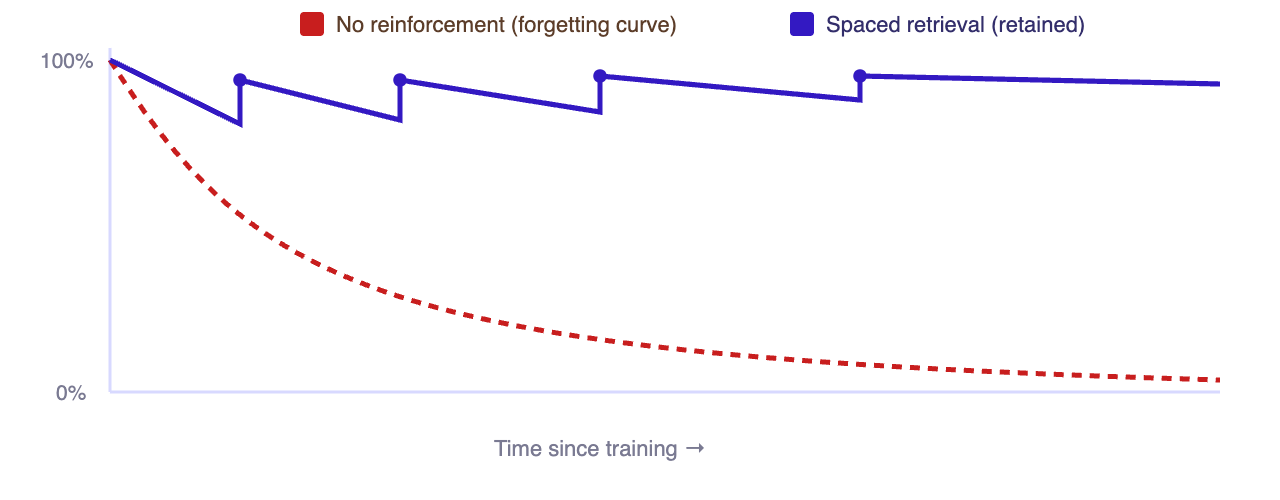
In the 1880s, psychologist Hermann Ebbinghaus ran a series of memory experiments on himself, testing how quickly he forgot lists of nonsense syllables over time. The result is now a foundational finding in cognitive science: the forgetting curve. Without reinforcement, memory decays fast and front-loaded: a sharp drop in the first hours and days after learning, followed by a slower, longer decline.
Applied to a workplace, this explains a familiar pattern: an employee walks out of a training session able to recite the material, then struggles to reconstruct it during a real incident three weeks later. The content was learned. It was not retained. A single exposure, however well-designed the session, is not enough to move information into durable, long-term memory.
What Actually Fixes It: Spaced Repetition and Retrieval Practice
Cognitive science has also identified what counters the forgetting curve, and it is not "more training." Two mechanisms do the work:
- Spaced repetition: reviewing material at increasing intervals, timed to intercept the point where memory is about to decay, rather than reviewing everything on a fixed schedule regardless of need.
- Retrieval practice: the act of pulling information back out of memory (being quizzed, prompted, or tested) strengthens the memory trace far more than passively re-reading or re-watching the same material.
Neither idea is new; both are well-established in learning-science literature. Combined, they form what researchers call spaced retrieval: actively recalling material at intervals timed to each person's forgetting. What has changed is the ability to run it at scale. That is what Blank Slate is: AI-optimized spaced retrieval, tracking for each individual employee exactly which knowledge is decaying and exactly when to intervene, instead of relying on a training calendar that treats every employee's memory the same way.
What This Looks Like in a Randomized Controlled Trial
The strongest evidence isn't theoretical, and it starts in the lab. A four-week randomized controlled trial across six U.S. universities and colleges put Blank Slate head-to-head against daily review (McHugh et al., Education Sciences, 2021). Students who did no review at all actually forgot, with scores falling below where they started. Students using Blank Slate climbed to near-perfect scores, and they got there in about one-third of the study time that daily review required. A follow-up study asked a bolder question: could the app replace the lecture entirely? Students who learned a topic through Blank Slate alone, never attending any lecture on it, matched their performance on lectured material in roughly 36 minutes of total study time against a 50-minute lecture (Gordon, Hughes & Smith, Teaching of Psychology, 2025).
The question that matters for a workforce is whether those lab results survive contact with the field. U.S. Air Force Special Warfare trainees using Blank Slate saw knowledge accuracy rise from 67% on day one to 81% by week 16, while the weekly time needed to sustain it fell from six-to-nine minutes early in the course to under a minute, about 100 seconds per week on average (I/ITSEC 2023, Amy Smith, PhD). The pattern repeated with fully qualified F-16 and C-17 pilots: first-attempt accuracy improved from 66.9% to 81.4%, a 21.6% relative gain, in sessions of about three minutes, and every pilot surveyed at exit said the app had helped their knowledge and operational performance at least somewhat (Smith & Randolph, I/ITSEC 2026). And it holds on a hospital floor: in a peer-reviewed pilot co-authored with Mass General nursing leaders, six weeks of two-to-three-minute Blank Slate reviews each workday significantly improved nurses' fall-prevention knowledge, confidence, and safety-checklist completion (Journal of Patient Safety, 2025).
Lab, classroom, training pipeline, cockpit, hospital: the setting changes and the pattern doesn't. Retention rises while the time cost falls, because Blank Slate targets each person's actual gaps instead of re-running the same course for everyone.
A Framework for Retention-First Training Design
Most corporate training is built around delivery: get the content in front of the employee once, mark it complete, move on. A retention-first design asks a different question at every stage: will this still be recallable in three months? Here is a simple framework:
- Diagnose before you deliver. Identify which knowledge gaps actually exist per employee or per role, rather than assuming everyone needs the same refresh.
- Break content into retrievable units. Long modules compress poorly into memory. Small, testable units are easier to reinforce individually.
- Schedule reinforcement around forgetting, not the training calendar. A quarterly all-hands refresher ignores that different employees forget different things at different rates.
- Make recall the measurement. Completion is not evidence of retention. Testing whether someone can retrieve and apply the knowledge is.
- Keep the time cost small. Reinforcement that takes minutes a week gets sustained; reinforcement that takes hours gets abandoned.
Where Training Software Stops and Readiness Begins
Learning management systems are built to deliver and track content: assign a course, log a completion, generate a compliance report. That is a real and necessary function, and it is not going away. But an LMS was never designed to answer a different question: does the employee still know this, and can they act on it under pressure, weeks after the course ended? Those are two different jobs, measured two different ways, and conflating them is a large part of why so much training budget produces so little durable knowledge.
- Job to be done: Primary function · Learning Management System: Deliver, assign, and track content completion · Knowledge-retention layer: Detect and close individual knowledge gaps over time
- Job to be done: Core metric · Learning Management System: Course completion rate · Knowledge-retention layer: Retained, retrievable knowledge
- Job to be done: Cadence · Learning Management System: Scheduled courses and annual refreshers · Knowledge-retention layer: Continuous, adaptive to each person's decay rate
- Job to be done: Employee time · Learning Management System: Hours, in blocks · Knowledge-retention layer: Minutes a week
- Job to be done: What it answers · Learning Management System: "Did they take the course?" · Knowledge-retention layer: "Can they still use it?"
That gap is why Blank Slate exists alongside an LMS rather than instead of one. Blank Slate is a cognitive-readiness platform: it sits on top of existing training content, continuously detects where each employee's knowledge is decaying, and closes those gaps through short, adaptive, spaced-retrieval sessions, typically just a few minutes a week. It is not another course to assign, and it does not ask an organization to rebuild its content library or replace the system it already uses for compliance and tracking. It is the layer that makes sure the courses you have already built actually stay retained, by continuously testing recall and reinforcing exactly the material that is starting to fade for each individual employee. For teams that want a deeper look at how this plays out day to day, our piece on knowledge retention in the workplace walks through what continuous reinforcement looks like in practice, and our guide to microlearning covers how to structure content into the small, retrievable units this approach depends on.
Frequently Asked Questions
Is employee retention training the same as reducing employee turnover?
No. "Retention training" is sometimes used to describe programs aimed at keeping employees from leaving the company. This article addresses knowledge retention: whether employees remember and can apply what they were trained on. That is a distinct, though related, business problem.
How long does trained knowledge actually last without reinforcement?
Per the Ebbinghaus forgetting curve, most unreinforced learning decays quickly in the first hours and days, then more gradually afterward. The exact rate varies by content and individual, which is why targeted, per-person reinforcement outperforms a single fixed refresher schedule.
Does this replace our LMS?
No. An LMS is built for content delivery, assignment, and compliance tracking. A knowledge-retention layer like Blank Slate coexists with it, working on top of existing course content to make sure what gets delivered is still retrievable weeks or months later.
What does a retention program cost in employee time?
In the USAF Special Warfare study, trainees averaged about 100 seconds of app use per week across 16 weeks, starting at six-to-nine minutes weekly and falling below one minute as the material was mastered (I/ITSEC 2023). That is evidence that well-targeted reinforcement gets cheaper over time, not more burdensome.
Curious where your own team's knowledge gaps actually are? A Knowledge Gap Audit takes a look at your current training content and shows you, concretely, where retention is likely breaking down, with no commitment and no rip-and-replace of your existing LMS. It is the fastest way to see whether a retention layer would move the needle for your team.