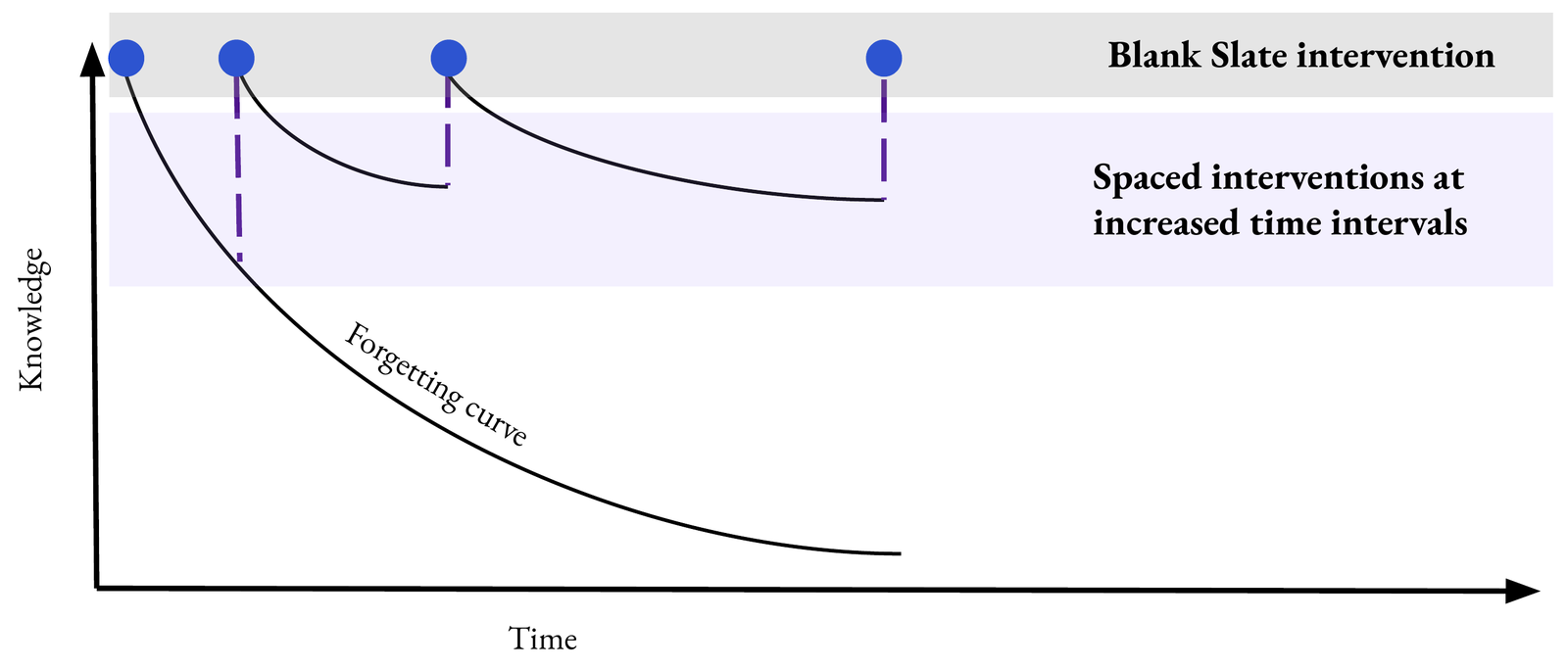
How Blank Slate fights the forgetting curve
Blank Slate uses cognitive science and machine learning to reinforce critical knowledge at the right time for the right person.
/ Healthcare Research Brief
What published research tells us about knowledge retention after training, the role of ongoing reinforcement, and how healthcare leaders can identify where their teams need support.
/Executive summary
Knowledge and skills can decline after training, making ongoing assessment and reinforcement important.
Course completion does not show what employees can recall weeks or months later.
Retained knowledge is one part of safe care, alongside practical skills, staffing, workflows, equipment, and communication.
Use ongoing assessments and personalized reinforcement to identify gaps and focus support where it’s needed most. Peer-reviewed randomized trials show durable retention improves with a few 60-second sessions per week.
/The problem, quantified
Healthcare invests enormously in initial training and certification. But the forgetting curve does not respect a compliance calendar. In a widely cited evaluation of resuscitation training, nurses' pass rates on advanced life-support skills fell to roughly 30% at three months and 14% at twelve months after certification. Skills degrade even faster than knowledge, with measurable decline in as little as two weeks.
The result is a persistent, invisible gap: a clinician is "current" on paper while their actual readiness has quietly eroded.
How Blank Slate fights the forgetting curve
Blank Slate uses cognitive science and machine learning to reinforce critical knowledge at the right time for the right person.
/Where the numbers mislead
Training completion is important for compliance, but it provides only part of the picture of ongoing readiness. That is a real compliance need, but it is a poor proxy for readiness. Attendance, seat time, and same-day quiz scores all measure the moment of instruction, not the moment of care weeks later when it matters.
Completion tells you training occurred. Ongoing assessment helps show what employees retain.
The measurement problem at the heart of frontline training
Measuring knowledge recall over time helps leaders identify gaps and focus reinforcement where it’s needed most. Closing it requires measuring retention and readiness over time, per person, and acting on the decay before it reaches the bedside.
/What the evidence shows works
Blank Slate's approach, a blend of cognitive science and machine-learning-driven spaced repetition that predicts and targets the knowledge each person is about to forget, is grounded in peer-reviewed randomized controlled trials.
67% → 81%
Knowledge retention over 16 weeks of reinforcement (USAF Special Warfare).
I/ITSEC 2023
3× faster
To knowledge mastery vs. traditional study, in a randomized controlled trial.
McHugh et al., 2021
<2 min/wk
Average weekly time to maintain that knowledge, a lighter load, not a heavier one.
I/ITSEC 2023
A 2025 pilot involving nursing staff evaluated six weeks of spaced review focused on fall prevention. The study reported improvements in fall-prevention knowledge, self-efficacy, perceived safety performance, and Fall TIPS poster completion. It did not detect a change in patient fall rates during the study period.
/What good looks like
Organizations that close the retention gap tend to share four traits. They treat readiness as a living state to be maintained, not a certificate to be filed.
Track whether critical knowledge is retained weeks and months out, per person, not just completion on day one.
A few 60-second sessions per week close the knowledge gap.
Focus reinforcement on each clinician’s knowledge gaps and what they are most likely to forget.
Works with existing LMSs and training programs so compliance records stay intact while readiness improves.
/Methodology and sources
This report synthesizes published patient-safety and training-retention research with Blank Slate's peer-reviewed study results. External statistics are attributed to their original sources below; Blank Slate figures are from randomized controlled trials and field evaluations. The forgetting-curve chart is a conceptual diagram provided by Blank Slate, not a specific dataset.
Our free Knowledge Gap Audit gives you a snapshot of what your team can recall today, using questions tied to your procedures, policies, or operational knowledge. Identify areas that need reinforcement and where to focus next.